

Key Takeaways
- Contact lenses correct vision by redirecting light to focus on the retina.
- Different lens types address myopia, farsightedness, astigmatism, and presbyopia.
- Soft, rigid, and specialty lenses each serve different needs and lifestyles.
- Most people adjust to contacts within 10 to 12 days.
- A contact lens exam with an optometrist helps to confirm the right fit and prescription.
Maybe you’ve grown tired of your glasses fogging up when you come inside from the cold. Or maybe you want a clearer view when you’re cheering on your kid at a Saturday morning hockey game. Contacts offer a different way to see the world, and a lot of people find them to be a comfortable, practical fit for everyday life.
Contact lenses correct vision by bending light so that it focuses directly on your retina, the tissue at the back of your eye that sends light signals to your brain. If you’re interested in contact lenses, our team at Vision for Life Eyecare offers contact lens exams and fittings to help you get started with the process.
The Science Behind Vision Correction
Your eye works a bit like a camera. Light enters, passes through the cornea and lens, then reaches the retina at the back of your eye. For people with normal vision, this process goes off without a hitch.
However, for people with nearsightedness or farsightedness, the shape of the eye bends light so that it doesn’t focus directly on your retina. The result is what we call a refractive error. Nearsightedness, farsightedness, and astigmatism are common examples of refractive errors.
Nearsightedness (Myopia) and Farsightedness (Hyperopia)
In people with myopia, the eyeball is a little too long or the cornea is curved too steeply. This causes light to focus in front of the retina rather than on it, causing distant objects to look blurry. A contact lens designed for myopia is thinner at the centre, which spreads light out before it enters the eye.
Farsightedness works the opposite way. In people with farsightedness, the shape of the eye causes light to focus behind the retina, making nearby objects hard to see clearly. Contact lenses with thicker centres bring that focal point forward, creating clear vision.
Astigmatism and Presbyopia
Astigmatism happens when the cornea is irregularly shaped, more like a football than a soccer ball. Light scatters differently at different points on the ocular surface, making things blurry at all distances. Astigmatism is often corrected with toric lenses, which use different corrective powers to account for the uneven shape of the cornea.
Presbyopia is a condition that many people start to notice in their 40s. As we age, the natural lenses of our eyes start to lose flexibility, making it harder to focus on close-up objects. Presbyopia is often corrected with multifocal lenses, which are split into different zones that correct vision at multiple distances.
Types of Contact Lenses and How They Differ
The two main kinds of lenses are soft lenses and rigid gas-permeable lenses. Soft lenses are flexible, sit comfortably on the eye, and are the most commonly worn variety. Rigid gas permeable lenses are firmer and can offer sharper vision in some cases.
Wear and Replacement Schedules
Within the soft lens category, you have a few options based on how often you replace them:
- Daily disposables come in a fresh pair each morning with no cleaning required.
- Two-week lenses are replaced every two weeks and require daily cleaning and proper storage between wears.
- Monthly lenses are cleaned and stored each night before wearing them again the next day.
Rigid gas permeable lenses are worn during the day for longer periods, and may last up to 2–3 years.
Specialty Contact Lenses
Some lenses are designed to perform additional, specific functions. These include:
- Multifocal lenses, which combine near and distance vision correction.
- Orthokeratology lenses, often called ortho-k, work by reshaping the cornea. These lenses are worn overnight rather than during the day.
- Scleral lenses, which are larger lenses that vault over the cornea and rest on the white of the eye. They can be helpful for people with dry eyes or certain corneal conditions.
The Benefits of Contacts Over Glasses
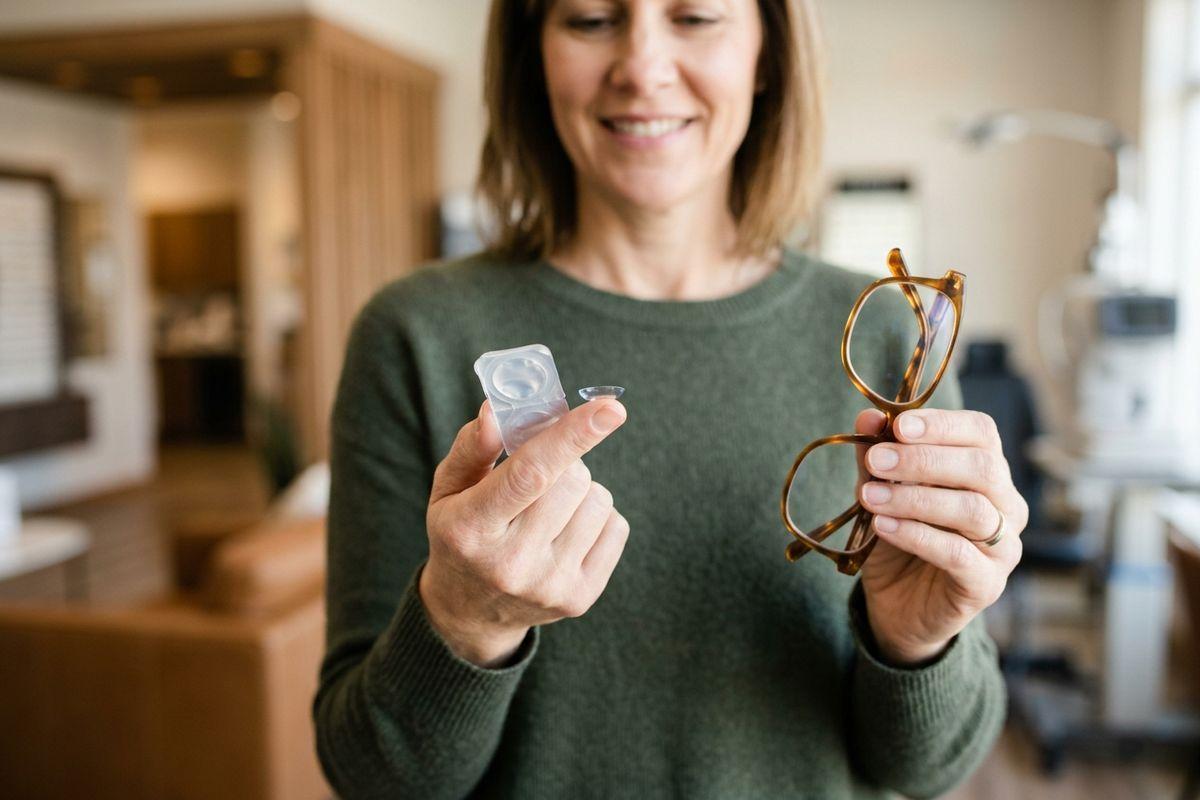
Glasses are a reliable option, but contact lenses offer a different experience. Because contacts don’t have frames, they provide a wider, unobstructed field of vision. Other benefits include:
- No fog when you step in from the cold or take a sip of hot soup.
- No smudges to clean off mid-afternoon.
- No slipping during physical activity or sports.
What to Expect When You Start Wearing Contacts
If you’ve never worn contacts before, there’s a little bit of a learning curve involved. Most people find that inserting and removing lenses feels natural within a week or two. Your first few attempts might feel awkward, but that’s completely normal. With time, the process should feel natural.
Caring for Your Contacts
Good habits go a long way in keeping your eyes healthy and your lenses comfortable. Make sure to:
- Always wash your hands thoroughly before touching your lenses.
- Never rinse or store contacts in water, including tap or bottled water. Use only contact lens solution.
- Stick to your replacement schedule. Wearing lenses longer than recommended can irritate your eyes over time.
- Your optometrist may recommend a specific contact lens solution based on your eyes and the type of lenses you wear. It’s generally best to stick with the recommended solution rather than switching between brands. Different solutions contain different ingredients, and using a product that isn’t compatible with your lenses or eyes can sometimes lead to irritation or discomfort.
Signs That Your Eyes May Need Attention
Most people can wear contacts without any issues, but sometimes problems do arise. Make sure to pay attention to:
- Redness, pain, or sudden blurry vision that doesn’t clear up.
- Eyes that feel significantly drier or more irritated than usual.
- Discharge or unusual sensitivity to light.
If any of these issues come up, remove your lenses right away and reach out to your optometrist. For serious situations, we also offer emergency eye care if something feels urgent and needs prompt attention.
Talking to Your Optometrist About Contacts
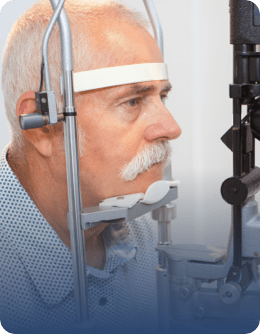
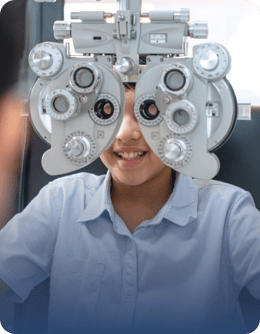
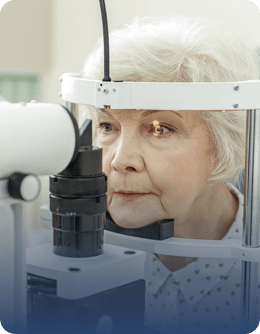
In order to get wear contacts, you’ll need to schedule a contact lens exam. As part of this appointment, an optometrist will check the shape of your cornea, assess your tear production, and look at your overall eye health to figure out which lens type will work best for your eyes.
At Vision for Life Eyecare, our team is here to help you decide whether contact lenses are a good fit for your vision needs and lifestyle. Whether you’re just curious or ready to book a contact lens exam, reach out today and take the next step toward comfortable, clear vision.